
The article addresses a reader decision using primary sources and clearly labelled illustrative examples. It does not rank every available product.
Commercial status: There are no affiliate links in this edition. Providers did not pay for inclusion or approve this copy.
The UK BNPL rules introduced on 15 July 2026 changed the treatment of covered agreements, rather than creating a single protection for everything labelled pay later. The useful starting point is the agreement: its date, lender and type determine which route needs checking.
This is continuing guidance, checked on 15 October 2026. A regulated agreement can still be a poor fit for a household's payment dates. Establishing its scope and testing its repayment schedule are separate decisions; neither can replace the other.
The agreement matters more than the checkout label
The FCA began regulating covered third-party deferred-payment credit on 15 July. Agreements made before that date remain exempt under this new regime.
The scope has exclusions, including certain employer and social-landlord arrangements. Deferred-payment credit broking is exempt. A merchant instalment label alone does not establish coverage.
That distinction prevents two opposite mistakes: treating every older purchase as newly regulated, and assuming an excluded agreement has no protections of any kind. This article does not determine the legal position of an individual transaction. If the documents leave coverage unclear, ask the lender to identify the agreement type and the applicable complaint process in writing.
Build an agreement passport

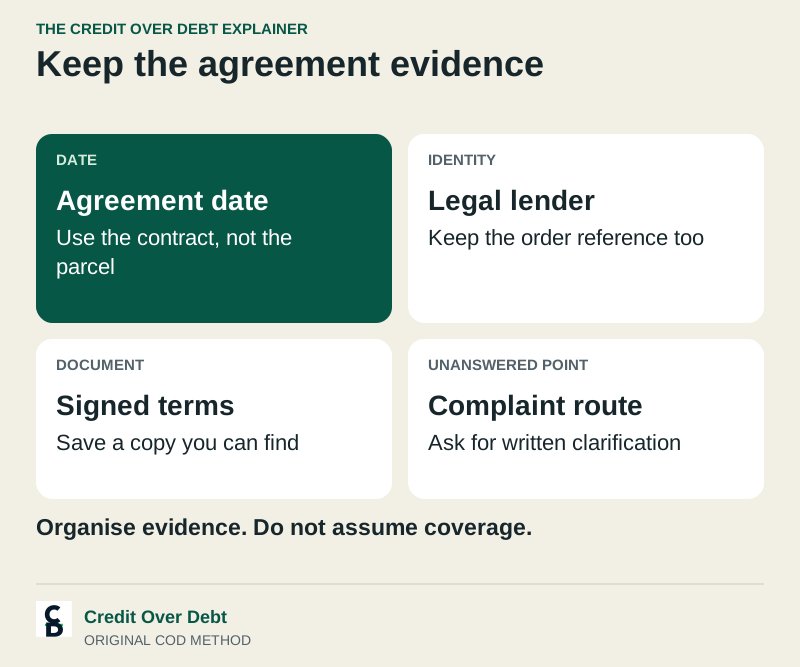
Read infographic as text
- Record the agreement date rather than the delivery date.
- Save the legal lender name and purchase reference.
- Keep the signed terms with the purchase record.
- Ask which protections and complaint process apply; this record does not determine legal coverage.
Our agreement passport is a small evidence record you can keep on paper or in a notes file. Give each purchase its own entry. Record the agreement date, the lender's legal name, the shop, the order reference and where the signed terms are saved. Use the contract date rather than the date a parcel arrived.
Add two questions beneath those details: which protections does the lender say apply, and where does a complaint go first? Keep the answer with the documents. A screenshot of a checkout logo cannot settle either question. If an account contains several purchases, do not assume that the answer for the newest agreement also covers the oldest.
The passport is an original organising method, not a regulator's form or a test that guarantees redress. Its value is making missing evidence visible before a dispute. It also gives you a stable reference when a purchase moves from an order screen to a lender's account screen.
Affordability checks leave a household decision open
The FCA and Treasury describe clearer information, responsible affordability checks and support in financial difficulty as aims of the regime.
A provider's acceptance does not answer whether several payments will collide before your next income arrives. Use the actual schedule to build a second record: amounts and dates. Our BNPL payment map shows how to bring separate purchases together. Include commitments already agreed elsewhere, rather than testing the new purchase in isolation.
For an illustrative example, invent a £240 purchase split into three equal £80 payments. If an £80 payment falls in the same period as existing £60 and £45 instalments, the combined commitment is £185. These are invented planning amounts, not lender terms or a measure of typical borrowers. The calculation identifies a busy period; it does not decide what that household can afford.
Write down money already committed to essential bills before assigning the remaining cash to a purchase. If the plan only works with uncertain overtime or an expected refund, show that dependency explicitly. Paying from available money, reducing the basket or waiting may avoid creating the next payment date. A credit card adds its own repayment task; our minimum-payment guide explains why a small required payment is not a payoff plan.
A return needs its own evidence trail
Treasury describes enforceable refund rights for faulty goods under covered BNPL. That does not establish that a particular claim will succeed.
Separate the goods record from the payment record. Save the order, delivery evidence, description of the fault and messages about the remedy requested. Alongside them, keep the lender's schedule and any written confirmation of a refund or adjustment. This separation helps identify what is actually unresolved: the shop's response, the financing balance, or both.
Do not remove an instalment from your calendar merely because a return is on its way. Keep the scheduled commitment visible until the provider confirms a change. If the two account screens disagree, ask for a written reconciliation quoting the order and agreement references. An expected refund is not cash already received.
Prepare the complaint around the unresolved point
The Financial Ombudsman Service says its BNPL route concerns agreements from 15 July with regulated firms. Complain to the provider first; if unhappy with its response, check the Ombudsman's process.
A useful complaint identifies the agreement, the specific problem and the result requested. Attach the relevant passport entry and a short dated sequence of events. Keep evidence that supports the point, rather than a long unlabelled collection of screenshots. This is preparation for a review, not a prediction of its outcome.
If payments are becoming difficult, contact the provider about support and consider independent debt help through MoneyHelper. A new checkout agreement should not be the assumed solution to an existing gap. Before another purchase, save its agreement passport and payment schedule together. Compare any interest, fees and total repayment using our credit-cost guide, then settle the unanswered coverage question before accepting the terms.
From comparison to calculation
Check the terms in the offer you actually receive.
Credit Over Debt’s Offer X-Ray compares the amount financed, fees, payment schedule and modeled cost using the figures you enter.
Open the free toolkitPrimary sources and product pages
- Financial Conduct Authority: Regulating Buy Now Pay Later (checked 2026-10-15)
- HM Treasury: Government delivers fairer deal as BNPL rules come into force (checked 2026-10-15)
- Financial Ombudsman Service: BNPL complaints from 15 July (checked 2026-10-15)
Product details last checked Oct 15, 2026; next scheduled review Nov 7, 2026. This UK-focused guide is educational information, not individualized financial, legal or tax advice. Product terms, offers and eligibility can change.